
We conducted a study for Eurofi[1] on the decarbonisation of the portfolios of six major banks from six European Union countries. The findings should be of interest to all those involved in tackling climate change and should encourage scrutiny of the transition plans published by major companies.
[1] “Transition plans of major EU banks”, Eurofi policy note, September 2026
Main findings of the study
Major European banks published transition plans in 2025 and 2026 in accordance with the CSRD (Corporate Sustainability Reporting Directive), which applies to all very large companies, as well as the CRD6 (Capital Requirements Directive 6), which applies specifically to the banking sector.
The analysis of transition plans published by major banking groups in the European Union is made difficult by the length and heterogeneity of the disclosures. Nevertheless, they contain valuable information, particularly on the decarbonisation targets for banks’ lending portfolios in carbon-intensive sectors and on their 2025 (or 2024) results relative to those targets.
Major banks in the European Union publish 2030 decarbonisation targets for their lending portfolios in all, or almost all, of the following carbon-intensive sectors: oil and gas, power generation, automotive, steel, cement, aviation, commercial real estate and residential estate. Some also include aluminium and shipping, while a few include coal, which most have ceased financing. They also publish results achieved in 2025 (or more rarely 2024), making it possible to assess their progress relative both to a baseline year – generally 2020, 2021 or 2022 – and to their stated targets.
These disclosures are harmonised and therefore comparable, as they are based on the same scenarios developed by international organisations, particularly the International Energy Agency, and use similar methodologies. This harmonisation is a legacy of the Net-Zero Banking Alliance, created in April 2021, of which these banks were members until its dissolution in October 2025 following the withdrawal of US banks.
We chose to compare the carbon trajectories of six major banking groups headquartered in six different European Union countries: BBVA (Spain), BNP Paribas (France), Deutsche Bank (Germany), ING (Netherlands), Intesa Sanpaolo (Italy) and Nordea (Finland).
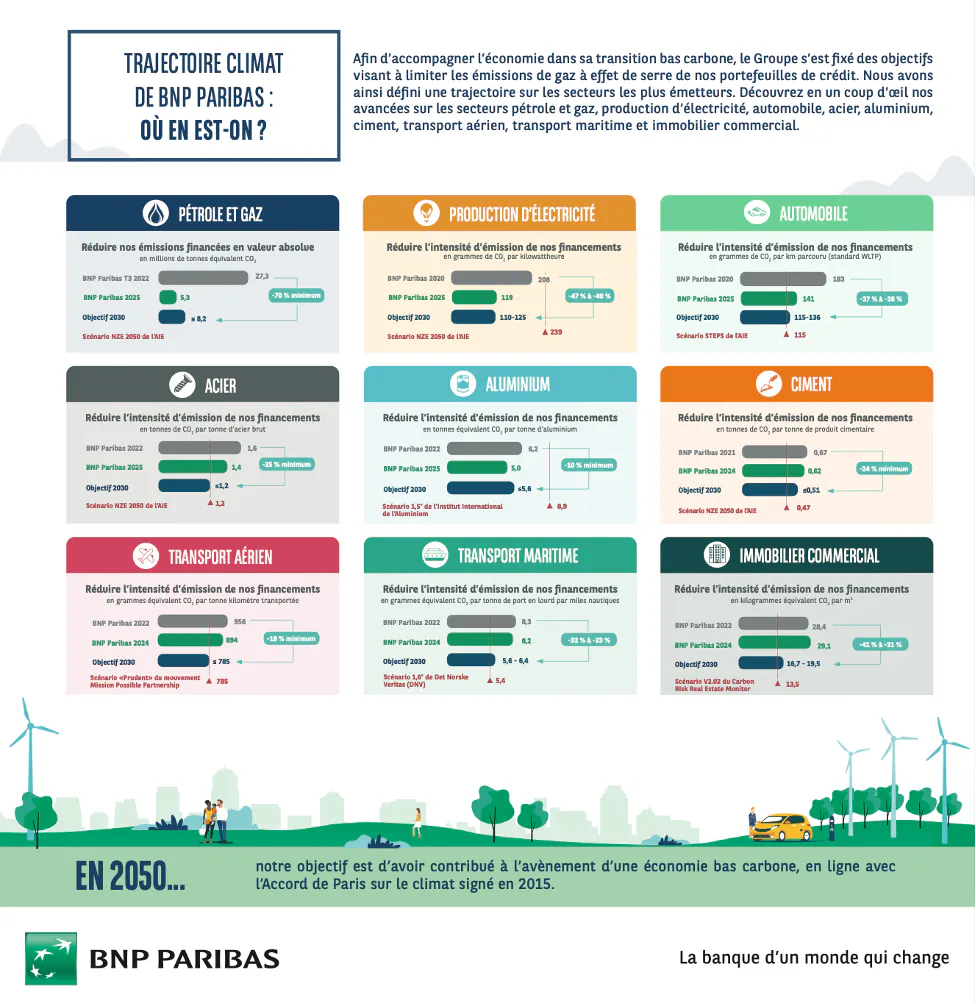
The reader will find in the annex an example of the decarbonisation trajectory of BNP Paribas, with the units specific to each sector. The comparison of the banks sector by sector can be summarised in the charts below, which show the targets and most recent results using a starting-point index of 100.
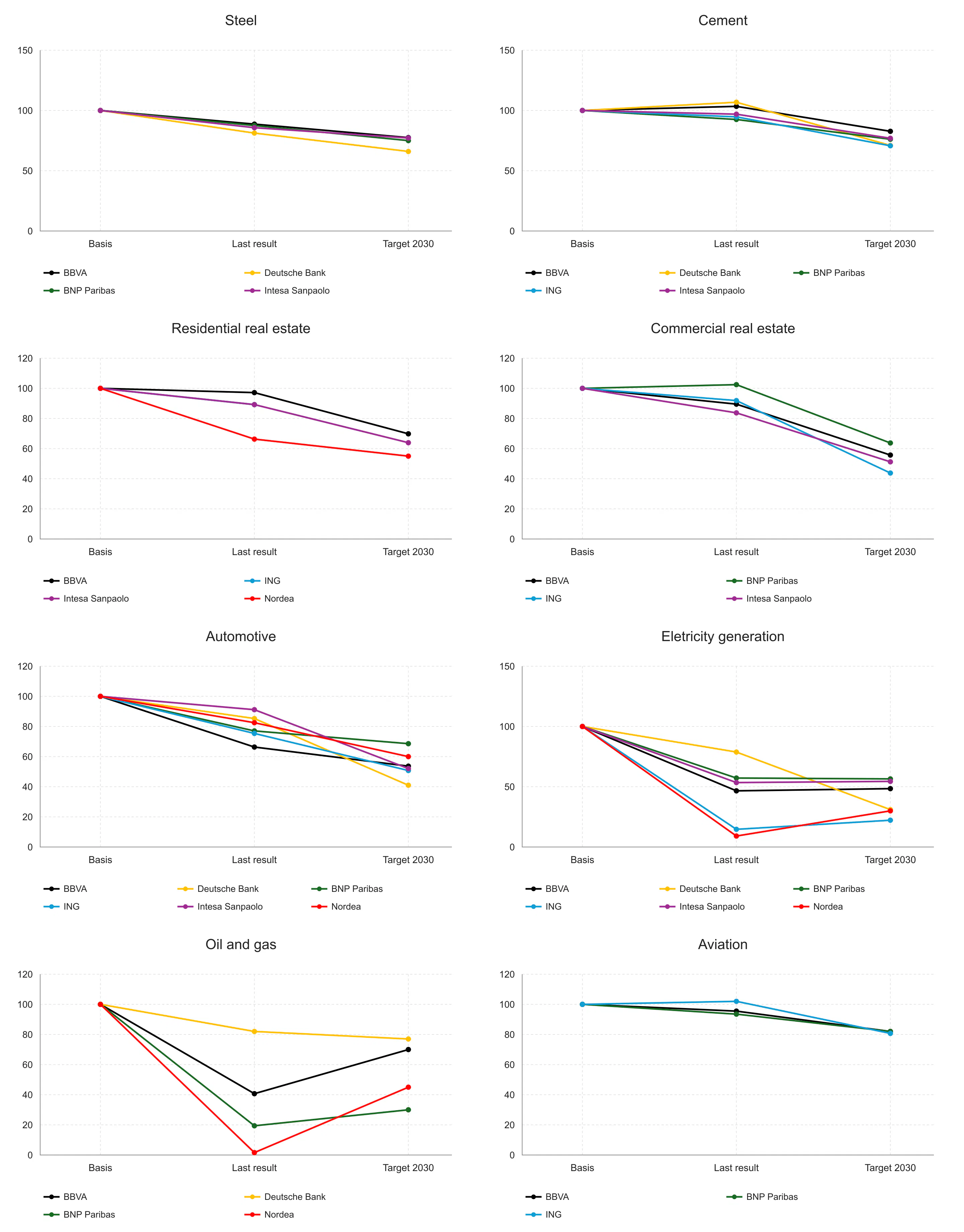
These charts reveal similarities between the six banks in some sectors, but also significant differences in others.
For oil and gas, there are striking differences in both targets and results. BNP Paribas and Nordea have the most ambitious targets, at around -70% and -50% respectively[2], and their latest results are already better than their targets. Deutsche Bank and BBVA are in line with, or even ahead of, their targets, although these targets are less ambitious, at -20% and -30% respectively.
[2] For ease of reading, the percentages have been rounded to the nearest ten percentage points (for example, -40%) and, in some cases, to the nearest five percentage points (for example, -35%).
For power generation, there are also substantial differences in targets and results. ING, Deutsche Bank and BNP Paribas have the most ambitious targets: -80% for ING and -70% for the other two. Nordea and ING have already exceeded their targets, reaching around -90%, while Deutsche Bank is lagging behind at around -20%. The other three banks are broadly in line with their less ambitious targets of approximately -30%.
For the automotive sector, targets are relatively aligned, ranging between -45% and -60%, while results are also relatively close, at around -20%, and broadly consistent with the targets, with the exception of Deutsche Bank and Intesa. Deutsche Bank has the most ambitious target (-60%) but a result slightly below the average of the other banks. Intesa’s result (-10%) is lower than that of the other banks.
For steel, targets are similar, at around -30%, and the latest results are broadly aligned with them, ranging from -10% to -20%. Deutsche Bank has the most ambitious target (-35%) and the strongest result (-20%).
For cement, targets are relatively similar, ranging from -20% to -30%, but the latest results vary considerably. Deutsche Bank and BBVA have recorded an increase in the carbon intensity of their portfolios of around +5%, while the other three banks report declines broadly aligned with their targets, ranging from -5% to -10%.
For commercial real estate, targets are relatively similar and ambitious, ranging from -45% to -60%, but the latest results differ and are generally rather disappointing. BNP Paribas has not reduced the carbon intensity of its portfolio, while BBVA and ING have reduced it by 10% and Intesa by 20%.
For residential real estate, the targets of the four banks concerned are relatively ambitious, ranging from -30% to -40%. Nordea has the most ambitious target (-40%) and has already moved substantially towards it, reaching around -35%. ING and Intesa are progressing in line with their targets, at around -15%, while BBVA has not reduced the carbon intensity of this portfolio.
Finally, for aviation, the three banks concerned have the same target (-20%); ING has not reduced the carbon intensity of its financing, contrary to BNP Paribas and BBVA (-10%).
Conclusions of the study
Three conclusions can be drawn from this comparison regarding the level of ambition of the targets and the performance achieved during the first years of the transition, both by sector and by bank.
1)The stated targets are relatively ambitious
It should be recalled that the European Union’s ultimate objective is to reduce net greenhouse gas emissions to zero by 2050. Against this background, the 2030 targets of the six banks can be regarded as ambitious for oil and gas (-60% on average), automotive (-50%), commercial real estate (-55%) and residential real estate (-40%). They also appear broadly consistent with the 2050 net-zero objective for steel (-30%), cement (-25%) and, to some extent, aviation (-20%).
Differences between banks are generally limited, except in oil and gas and power generation, where they may reflect national economic specificities.
2) On average, results are satisfactory relative to the targets
Most results are broadly aligned with the stated targets. There are some notable cases of outperformance, particularly Nordea and BNP Paribas in oil and gas, and Nordea and ING in power generation.
There are also cases where progress is lagging behind the targets, such as Deutsche Bank in power generation and Intesa in the automotive sector, and in some cases there has been little or no progress since the baseline year, including BBVA and Deutsche Bank in cement, ING in aviation, and BNP Paribas in commercial real estate.
The sectors in which portfolio decarbonisation is least advanced are cement, aviation and commercial real estate. The difficulty of decarbonising cement and aviation is well known and is reflected in the banks’ targets. The limited progress in commercial real estate is more surprising.
3) It would clearly be useful to broaden the scope of the study and better understand the factors behind the differences in targets and performance
In particular, it would be useful to distinguish between differences reflecting sector-specific constraints and those resulting from choices made by individual banks. This would require engaging directly with the banks themselves and cross-checking their responses against sectoral analyses.
It is to be hoped that banks’ disclosures will be assessed year after year, helping to track the trajectory of our economies towards decarbonisation.